Starship Tower Begins Rising at Historic Cape Launch Site
Construction at Space Launch Complex 37 is turning a former Saturn and Delta pad into a future home for SpaceX's Starship system.
A new shape is beginning to rise at Cape Canaveral Space Force Station, where one of the Space Coast's most historic launch sites is being prepared for its next generation of rockets.
SpaceX has begun stacking the first Starship integration tower at Space Launch Complex 37. When complete, the structure is expected to stand about 600 feet tall, according to the Department of the Air Force's final environmental review for the project.
The tower is part of a larger plan to redevelop SLC-37 for Starship and Super Heavy—the fully reusable launch system SpaceX has been flight-testing in Texas.
A launch pad with several lives
SLC-37 first supported Saturn rockets during the Apollo era. Decades later, it was rebuilt for the Delta IV family, including the Delta IV Heavy missions that became a familiar sight over the Cape.
The final Delta IV Heavy lifted off from the complex in April 2024. That closing chapter cleared the way for another transformation rather than a permanent retirement.
The Air Force completed its Final Environmental Impact Statement in November 2025. The selected plan allows SpaceX to redevelop SLC-37 for two Starship launch pads, each with an integration tower.
Environmental approval defines what the government studied and authorized at the site. It does not, by itself, guarantee a launch date or replace other approvals, including any Federal Aviation Administration licensing required for future flights.
What the plan allows
The environmental review analyzed a maximum operating scenario of up to 76 launches and 152 landings per year. Those figures are planning limits used to evaluate possible effects; they are not a promised flight schedule.
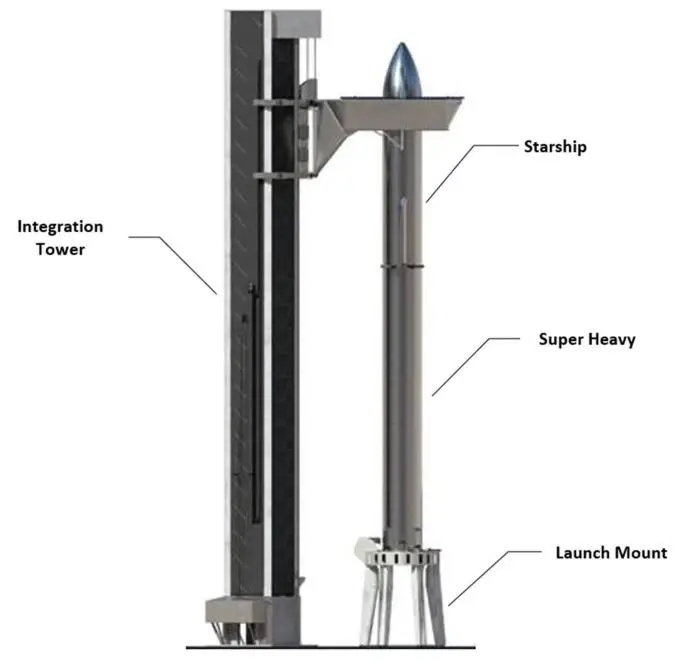
The document also describes tall integration towers, launch mounts, propellant storage, water systems and other infrastructure needed to support Starship and Super Heavy. The tower's mechanical arms are designed to help stack the two stages and support operations at the pad.
A notional layout from the Air Force's final environmental review shows the scale of the integration tower beside Starship and Super Heavy.
SpaceX has built tower sections away from the pad before moving them into position for stacking. That modular process lets crews outfit major pieces closer to ground level before a large crane lifts them into place.
Construction is moving quickly, so the number of completed sections can change from one day to the next. What is already clear is that the Cape's former Delta pad is no longer waiting for a future mission—it is actively being rebuilt for one.
Why it matters on the Space Coast
Launch pads here have rarely belonged to only one era. Facilities designed for early exploration have been adapted for national-security missions, commercial launches and new vehicles that did not exist when the concrete was first poured.
SLC-37 now joins that pattern. Saturn hardware once stood there. Delta IV rockets later lifted from the same complex. A 600-foot Starship tower rising above the scrub is the latest sign that the site still has another chapter ahead.
For residents watching the skyline, the tower is also a useful reminder: launch infrastructure arrives long before opening day. There is still substantial work between stacked steel and an operational pad, but the change is now visible.
Sources and useful links

Stephen Garcia
Stephen covers Brevard's wildlife, parks, science, launches, and aerospace workforce. He is drawn to the people doing technical or conservation work behind the scenes — and to explaining why that work matters close to home.