Fueled and Ready: Roman Space Telescope Nears Launch From Kennedy Space Center
Technicians at Kennedy Space Center have fueled NASA's Roman Space Telescope, clearing one of the final major milestones before its August 30 launch.
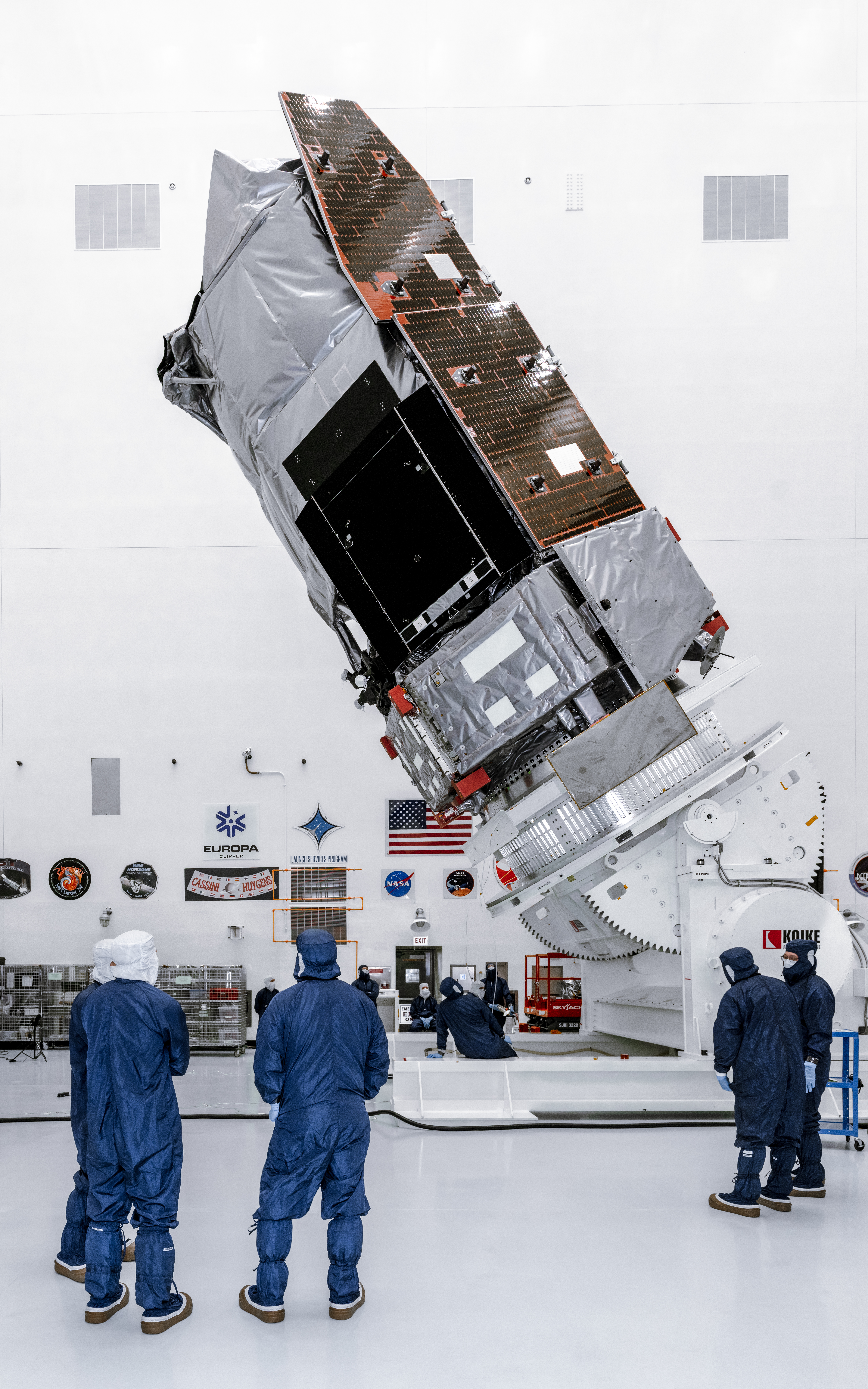
Technicians at Kennedy Space Center finished fueling NASA's Nancy Grace Roman Space Telescope on July 25, loading about 290 gallons of hydrazine into the observatory inside the Payload Hazardous Servicing Facility.
It is one of the last major milestones before Roman targets liftoff no earlier than 7:26 a.m. EDT on Sunday, August 30, aboard a SpaceX Falcon Heavy from Launch Complex 39A.
The mission is one of NASA's most anticipated astronomy projects in years—and the final launch preparation is happening here on the Space Coast.
What it means to fuel a telescope
Roman will not use its hydrazine to leave Earth. The Falcon Heavy handles the launch. The propellant aboard the spacecraft powers smaller thrusters used to correct Roman's trajectory, settle into its working orbit and keep the observatory positioned correctly throughout its mission.
Fueling is slow, controlled work. Technicians use full-body Self-Contained Atmospheric Protective Ensemble, or SCAPE, suits around the toxic propellant. The spacecraft is also highly sensitive to contamination, so teams must protect both the observatory and themselves while working in a tightly controlled clean-room environment.
NASA says Roman has enough fuel for its five-year primary mission and potentially another five years of extended operations.
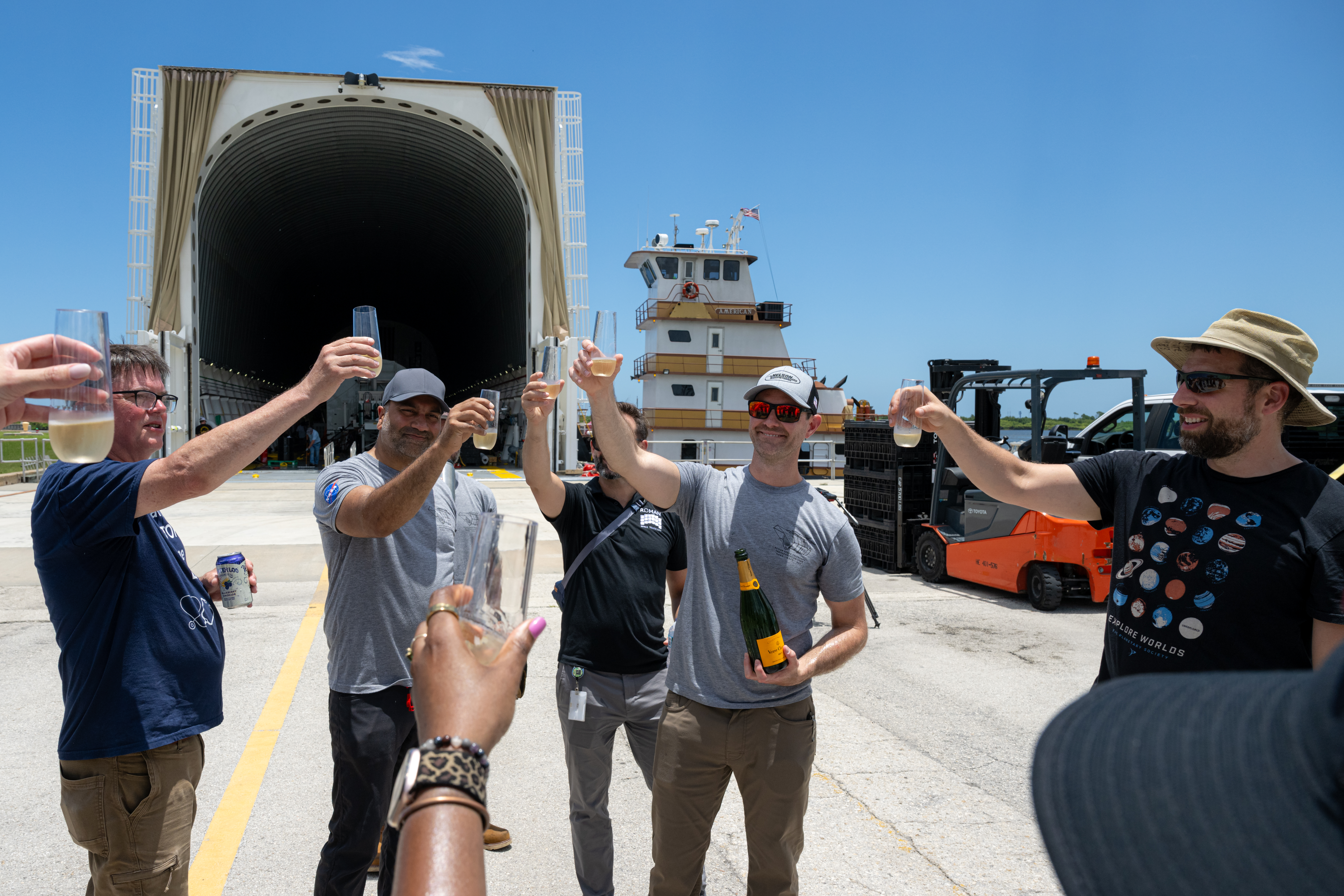
The Roman Space Telescope arrived at Kennedy Space Center in June aboard NASA's Pegasus barge. Photo: NASA/John Kraus.
A 40-year-old building doing new work
The Payload Hazardous Servicing Facility has supported spacecraft processing since 1986. Before Roman arrived, NASA upgraded the building's air-shower entry, climate-control and compressed-air systems and repainted the overhead crane to reduce the chance of microscopic debris falling onto the telescope.
The facility has previously supported missions connected to Hubble, the Mars 2020 Perseverance rover and Europa Clipper. Roman is the latest mission to pass through a building designed for the unusual combination of delicate clean-room work and hazardous fueling.
What Roman will study
Roman's primary mirror is the same diameter as Hubble's, but its wide-field instrument can see an area of sky at least 100 times larger in a single view.
That wider perspective will let Roman survey enormous portions of the universe. Scientists expect it to study billions of galaxies, discover thousands of exoplanets and help investigate dark energy—the still-unexplained force associated with the universe's accelerating expansion.
The telescope will travel roughly one million miles to Sun-Earth Lagrange Point 2, or L2, the same general region where the James Webb Space Telescope operates. Roman's broad surveys can identify promising objects and regions for Webb and other observatories to examine in greater detail.
What happens next
With fueling complete, technicians will attach Roman to hardware that connects it to the rocket's upper stage. The observatory will then be sealed inside the payload fairing that protects it during launch.
NASA maintains a Roman launch countdown and photo gallery with current mission updates. As with every launch, the date and time can change, so readers planning to watch should check the official schedule before heading out.
Sources and useful links

Claire Szewczyk
Claire has called Florida home for a decade, but her love of the Space Coast goes back further — to the beat-up Kennedy Space Center coffee table book she found in a thrift store when she was five. She writes about the people, places, and history that make Brevard County great, and those stories are where Brightside Brevard began.